×
× 




Bạn đang tìm lời giải chi tiết cho Cam 20 - Test 1 - Reading passage 1 về loài vẹt Kākāpō độc đáo của New Zealand? Bài viết này sẽ giúp bạn phân tích từng câu hỏi, hiểu rõ cách tìm đáp án và nâng cao kỹ năng Reading một cách hiệu quả nhất.
Cùng IELTS LangGo khám phá chi tiết cam 20 test 1 reading passage 1 với bài đọc về loài vẹt không biết bay đầy thú vị này nhé:
The kākāpō
The kākāpō is a nocturnal, flightless parrot that is critically endangered and one of New Zealand’s unique treasures
Vào thiên niên kỷ thứ nhất và thứ hai trước Công nguyên, cướp biển đã đi thuyền quanh Địa Trung Hải, tấn công tàu thuyền và trốn tránh những người truy đuổi.
The kākāpō, also known as the owl parrot, is a large, forest-dwelling bird, with a pale owl-like face. Up to 64 cm in length, it has predominantly yellow-green feathers, forward-facing eyes, a large grey beak, large blue feet, and relatively short wings and tail. It is the world’s only flightless parrot, and is also possibly one of the world’s longest-living birds, with a reported lifespan of up to 100 years.
Loài kākāpō, còn được gọi là vẹt cú, là một loài chim to sống trong rừng, có khuôn mặt nhợt nhạt giống cú. Với chiều dài lên tới 64 cm, nó có bộ lông màu xanh vàng, đôi mắt hướng về phía trước, mỏ to màu xám, chân to màu xanh lam và đôi cánh cùng đuôi khá ngắn. Đây là loài vẹt duy nhất trên thế giới không biết bay, và có thể cũng là một trong những loài chim sống lâu nhất, với tuổi thọ lên tới 100 năm.
The kākāpō are solitary birds and tend to occupy the same home range for many years. They forage on the ground and climb high into trees. They often leap from trees and flap their wings, but at best manage a controlled descent to the ground. They are entirely vegetarian, with their diet including the leaves, roots and bark of trees as well as bulbs, and fern fronds.
Kākāpō là loài sống đơn độc, thường ở một khu vực cố định trong nhiều năm. Chúng kiếm ăn trên mặt đất và leo lên các cây cao, đôi khi nhảy từ trên cây xuống và vỗ cánh để hạ cánh có kiểm soát. Chúng hoàn toàn ăn thực vật, bao gồm lá, rễ, vỏ cây, củ và chồi dương xỉ.
Kākāpō breed in summer and autumn, but only in years when food is plentiful. Males play no part in incubation or chick-rearing – females alone incubate eggs and feed the chicks. The 1–4 eggs are laid in soil, which is repeatedly turned over before and during incubation. The female kākāpō has to spend long periods away from the nest searching for food, which leaves the unattended eggs and chicks particularly vulnerable to predators.
Kākāpō sinh sản vào mùa hè và mùa thu, nhưng chỉ trong những năm có nguồn thức ăn dồi dào. Con đực không tham gia vào việc ấp trứng hoặc nuôi con – chỉ con cái đảm nhận nhiệm vụ này. Tổ trứng (1–4 quả) được làm trong đất, đất sẽ được đào xới nhiều lần trước và trong quá trình ấp. Con cái phải rời tổ trong thời gian dài để kiếm ăn, khiến trứng và chim non dễ bị kẻ săn mồi tấn công.
Before humans arrived, kākāpō were common throughout New Zealand’s forests. However, this all changed with the arrival of the first Polynesian settlers about 700 years ago. For the early settlers, the flightless kākāpō was easy prey. They ate its meat and used its feathers to make soft cloaks. With them came the Polynesian dog and rat, which also preyed on kākāpō. By the time European colonisers arrived in the early 1800s, kākāpō had become confined to the central North Island and forested parts of the South Island. The fall in kākāpō numbers was accelerated by European colonisation. A great deal of habitat was lost through forest clearance, and introduced species such as deer depleted the remaining forests of food. Other predators such as cats, stoats and two more species of rat were also introduced. The kākāpō were in serious trouble.
Trước khi con người xuất hiện, kākāpō phổ biến khắp các khu rừng của New Zealand. Tuy nhiên, điều đó thay đổi hoàn toàn khi người Polynesia đầu tiên đặt chân đến khoảng 700 năm trước. Với họ, loài vẹt không biết bay này là con mồi dễ bắt – họ ăn thịt chúng và dùng lông để làm áo choàng mềm. Cùng với con người, chó và chuột Polynesia cũng đến và săn bắt kākāpō. Đến khi người châu Âu đến vào đầu thế kỷ 19, kākāpō chỉ còn tồn tại ở trung tâm đảo Bắc và một số khu rừng trên đảo Nam. Sự suy giảm số lượng kākāpō tăng tốc khi người châu Âu định cư. Rừng bị chặt phá, nhiều loài xâm lấn như hươu đã làm cạn kiệt nguồn thức ăn, và các loài săn mồi mới như mèo, chồn, và hai loài chuột khác cũng được du nhập. Loài kākāpō khi đó đứng bên bờ tuyệt chủng.
In 1894, the New Zealand government launched its first attempt to save the kākāpō. Conservationist Richard Henry led an effort to relocate several hundred of the birds to predator-free Resolution Island in Fiordland. Unfortunately, the island didn’t remain predator free – stoats arrived within six years, eventually destroying the kākāpō population. By the mid-1900s, the kākāpō was practically a lost species. Only a few clung to life in the most isolated parts of New Zealand.
Năm 1894, chính phủ New Zealand bắt đầu nỗ lực đầu tiên để cứu kākāpō. Nhà bảo tồn Richard Henry đã di dời hàng trăm cá thể đến đảo Resolution – một hòn đảo không có thú săn mồi ở Fiordland. Tuy nhiên, chồn hương đã xâm nhập đảo chỉ sau sáu năm, tiêu diệt toàn bộ quần thể kākāpō tại đây. Đến giữa thế kỷ 20, kākāpō gần như tuyệt chủng hoàn toàn. Chỉ còn vài cá thể sống sót ở những vùng hẻo lánh nhất của New Zealand.
From 1949 to 1973, the newly formed New Zealand Wildlife Service made over 60 expeditions to find kākāpō, focusing mainly on Fiordland. Six were caught, but there were no females amongst them and all but one died within a few months of captivity. In 1974, a new initiative was launched, and by 1977, 18 more kākāpō were found in Fiordland. However, there were still no females. In 1977, a large population of males was spotted in Rakiura – a large island free from stoats, ferrets and weasels. There were about 200 individuals, and in 1980 it was confirmed females were also present. These birds have been the foundation of all subsequent work in managing the species.
Từ 1949 đến 1973, Cục Động vật hoang dã New Zealand đã thực hiện hơn 60 chuyến thám hiểm để tìm kākāpō, chủ yếu ở Fiordland. Họ bắt được sáu con, nhưng không có con cái nào, và tất cả trừ một con đều chết sau vài tháng bị nuôi nhốt. Năm 1974, một chiến dịch mới được khởi động, và đến 1977, tìm thấy thêm 18 cá thể ở Fiordland – nhưng vẫn không có con cái. Cùng năm đó, một quần thể lớn kākāpō đực được phát hiện trên đảo Rakiura, một hòn đảo không có chồn, chồn hôi hay chồn nâu, với khoảng 200 cá thể, và đến 1980, xác nhận có cả con cái. Đây là nền tảng cho mọi nỗ lực bảo tồn sau này.
Unfortunately, predation by feral cats on Rakiura Island led to a rapid decline in kākāpō numbers. As a result, during 1980–97, the surviving population was evacuated to three island sanctuaries: Codfish Island, Maud Island and Little Barrier Island. However, breeding success was hard to achieve. Rats were found to be a major predator of kākāpō chicks and an insufficient number of chicks survived to offset adult mortality. By 1995, although at least 12 chicks had been produced on the islands, only three had survived. The kākāpō population had dropped to 51 birds. The critical situation prompted an urgent review of kākāpō management in New Zealand.
Đáng tiếc, mèo hoang trên đảo Rakiura đã gây ra sự suy giảm nhanh chóng của quần thể này. Do đó, từ 1980–1997, những cá thể sống sót được di chuyển đến ba đảo an toàn hơn: Codfish Island, Maud Island và Little Barrier Island. Tuy nhiên, việc sinh sản vẫn gặp khó khăn, do chuột ăn thịt chim non, khiến số chim non sống sót không đủ để bù lại tỷ lệ chết của chim trưởng thành. Đến năm 1995, dù ít nhất 12 chim non đã nở, chỉ có 3 con sống sót, và tổng số lượng kākāpō chỉ còn 51 cá thể.
In 1996, a new Recovery Plan was launched, together with a specialist advisory group called the Kākāpō Scientific and Technical Advisory Committee and a higher amount of funding. Renewed steps were taken to control predators on the three islands. Cats were eradicated from Little Barrier Island in 1980, and possums were eradicated from Codfish Island by 1986. However, the population did not start to increase until rats were removed from all three islands, and the birds were more intensively managed. This involved moving the birds between islands, supplementary feeding of adults and rescuing and hand-raising any failing chicks.
Trước tình hình nghiêm trọng đó, một kế hoạch phục hồi mới được khởi động năm 1996, cùng với ủy ban cố vấn khoa học – kỹ thuật về kākāpō và nguồn tài trợ lớn hơn. Các biện pháp mạnh tay được thực hiện để kiểm soát thú săn mồi trên ba hòn đảo: mèo được tiêu diệt khỏi Little Barrier Island (1980) và thú có túi bị loại bỏ khỏi Codfish Island (1986). Tuy nhiên, số lượng kākāpō chỉ bắt đầu tăng khi chuột bị xóa sổ hoàn toàn và loài chim này được quản lý chặt chẽ hơn, bao gồm di chuyển giữa các đảo, cho ăn bổ sung, và cứu – nuôi thủ công chim non yếu.
After the first five years of the Recovery Plan, the population was on target. By 2000, five new females had been produced, and the total population had grown to 62 birds. For the first time, there was cautious optimism for the future of kākāpō and by June 2020, a total of 210 birds were recorded.
Sau 5 năm thực hiện Kế hoạch Phục hồi, số lượng kākāpō đã tăng đúng tiến độ. Đến năm 2000, có thêm 5 con cái mới, tổng số đạt 62 cá thể, và niềm hy vọng thận trọng cho tương lai của loài chim này lần đầu tiên xuất hiện. Đến tháng 6 năm 2020, tổng số cá thể kākāpō đạt 210 con.
Today, kākāpō management continues to be guided by the Kākāpō Recovery Plan. Its key goals are: minimise the loss of genetic diversity in the kākāpō population, restore or maintain sufficient habitat to accommodate the expected increase in the kākāpō population, and ensure stakeholders continue to be fully engaged in the preservation of the species.
Ngày nay, công tác bảo tồn kākāpō vẫn được hướng dẫn bởi Kế hoạch Phục hồi Kākāpō, với ba mục tiêu chính: giảm thiểu mất mát đa dạng di truyền của quần thể kākāpō, phục hồi hoặc duy trì môi trường sống đủ rộng để đáp ứng sự gia tăng dân số dự kiến và đảm bảo các bên liên quan tiếp tục hợp tác và cam kết trong công tác bảo tồn.
Questions 1-6
Do the following statements agree with the information given in Reading Passage 1?
In boxes 1-6 on your answer sheet, write
TRUE if the statement agrees with the information
FALSE if the statement contradicts the information
NOT GIVEN if there is no information on this
1. There are other parrots that share the kakapo’s inability to fly.
2. Adult kakapo produce chicks every year.
3. Adult male kakapo bring food to nesting females.
4. The Polynesian rat was a greater threat to the kakapo than Polynesian settlers.
5. Kakapo were transferred from Rakiura Island to other locations because they were at risk from feral cats.
6. One Recovery Plan initiative that helped increase the kakapo population size was caring for struggling young birds.
Questions 7-13
Complete the notes below.
Choose ONE WORD AND/OR A NUMBER from the passage for each answer.
New Zealand’s kakapo
A type of parrot:
diet consists of fern fronds, various parts of a tree and 7 _____
nests are created in 8 _____ where eggs are laid.
Arrival of Polynesian settlers
the 9 _____ of the kakapo were used to make clothes.
Arrival of European colonisers
10 _____ were an animal which they introduced that ate the kakapo’s food sources.
Protecting kakapo
Richard Henry, a conservationist, tried to protect the kakapo.
a definite sighting of female kakapo on Rakiura Island was reported in the year 11 _____.
the Recovery Plan included an increase in 12 _____
a current goal of the Recovery Plan is to maintain the involvement of 13 _____ in kakapo protection.
Phân tích đề và chiến lược làm bài:
Ở Passage này có 2 dạng câu hỏi chia thành 12 câu hỏi. Hãy cùng phân tích chiến lược làm bài của các dạng câu hỏi này nhé:
Dạng 1: Note completion:
Note!
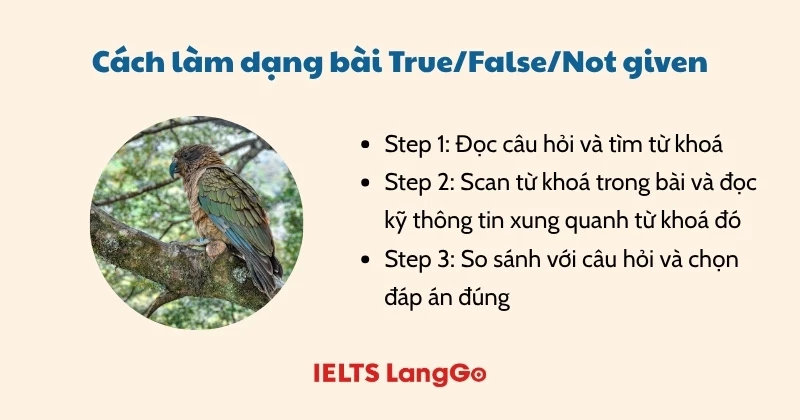
Dạng 2: True/False/Not given
Đây là đáp án của các câu hỏi trong passage này:
| Answer | |
| 1. FALSE | 8. soil |
| 2. FALSE | 9. feathers |
| 3. FALSE | 10. deer |
| 4. NOT GIVEN | 11. 1980 |
| 5. TRUE | 12. funding |
| 6. TRUE | 13. stakeholders |
| 7. bulbs | |
Phần the kakapo reading answers dưới đây sẽ giúp bạn hiểu rõ logic đằng sau mỗi câu trả lời và tránh được những "bẫy" phổ biến trong đề thi:
Đáp án: FALSE
Vị trí: Đoạn 1
Keywords câu hỏi: There are other parrots that share the kakapo’s inability to fly.
Keywords trong bài đọc: It is the world’s only flightless parrot, [...]
Giải thích:
Câu hỏi nói rằng có những loài vẹt khác cũng không thể bay giống kakapo nhưng trong bài lại nói kakapo là loài vẹt duy nhất không bay được
Đáp án: FALSE
Vị trí: Đoạn 3
Keywords câu hỏi: Adult kakapo produce chicks every year.
Keywords trong bài đọc: Kākāpō breed in summer and autumn, but only in years when food is plentiful.
Giải thích:
Câu hỏi nói rằng những con kakapo trưởng thành sinh con mỗi năm nhưng trong bài lại nói kakapo chỉ sinh sản vào những năm có nhiều đồ ăn.
Đáp án: FALSE
Vị trí: Đoạn 3
Keywords câu hỏi: Adult male kakapo bring food to nesting females.
Keywords trong bài đọc: Males play no part in incubation or chick-rearing – females alone incubate eggs and feed the chicks.
Giải thích:
Câu hỏi nói rằng những con kakapo đực trưởng thành mang đồ ăn về tổ cho con cái nhưng trong bài lại nói những con đực không tham gia vào việc ấp trứng hay nuôi dưỡng con non.
Đáp án: NOT GIVEN
Vị trí: Đoạn 4
Keywords câu hỏi: The Polynesian rat was a greater threat to the kakapo than Polynesian settlers
Keywords trong bài đọc: However, this all changed with the arrival of the first Polynesian settlers about 700 years ago. For the early settlers, the flightless kākāpō was easy prey. They ate its meat and used its feathers to make soft cloaks. With them came the Polynesian dog and rat, which also preyed on kākāpō.
Giải thích:
Câu hỏi nói rằng những con chuột Polynesia là mối đe doạ lớn hơn đối với kakapo hơn là những người định cư Polynesia nhưng trong bài chỉ nói cả 2 đều là mối đe doạ chứ không so sánh đâu là mối đe doạ lớn hơn.
Đáp án: TRUE
Vị trí: Đoạn 7
Keywords câu hỏi: Kakapo were transferred from Rakiura Island to other locations because they were at risk from feral cats.
Keywords trong bài đọc: Unfortunately, predation by feral cats on Rakiura Island led to a rapid decline in kākāpō numbers. As a result, during 1980–97, the surviving population was evacuated to three island sanctuaries: Codfish Island, Maud Island and Little Barrier Island.
Giải thích: Câu hỏi nói rằng những con kakapo được chuyển từ đảo Rakiura đến những nơi khác vì chúng bị đe doạ bởi mèo hoang, mà trong bài nói rằng sự săn mồi của những con mèo hoang ở đảo Rakiura dẫn đến sự giảm mạnh về số lượng những con kakapo nên những con còn sống đã được chuyển đến ba đảo khác.
Đáp án: TRUE
Vị trí: Đoạn 8
Keywords câu hỏi: One Recovery Plan initiative that helped increase the kakapo population size was caring for struggling young birds.
Keywords trong bài đọc: In 1996, a new Recovery Plan was launched, [...] However, the population did not start to increase until [...] the birds were more intensively managed. This involved moving the birds between islands, supplementary feeding of adults and rescuing and hand-raising any failing chicks.
Giải thích: Câu hỏi nói rằng một biện pháp trong kế hoạch phục hồi giúp làm tăng số lượng kakapo là chăm sóc những con non yếu mà trong bài có nói số lượng kakpo không tăng cho đến khi chúng được chăm sóc chuyên sâu hơn bằng việc cứu và nuôi dưỡng tận tay những con non bị ngã.
Đáp án: bulbs
Vị trí: Đoạn 2
Keywords câu hỏi: diet consists of fern fronds, various parts of a tree and 7 _____
Keywords trong bài đọc: They are entirely vegetarian, with their diet including the leaves, roots and bark of trees as well as bulbs, and fern fronds.
Giải thích: Câu hỏi hỏi thức ăn bao gồm chồi dương xỉ, nhiều phần khác nhau của cây và cái gì mà trong bài lại nói thức ăn của kakapo bao gồm lá, rễ của cây cũng như là các củ và chồi cây dương xỉ.
Đáp án: soil
Vị trí: Đoạn 3
Keywords câu hỏi: nests are created in 8 _____ where eggs are laid
Keywords trong bài đọc: The 1–4 eggs are laid in soil, which is repeatedly turned over before and during incubation.
Giải thích: Câu hỏi hỏi rằng những cái tổ được tạo thành ở đâu và chỗ đó cũng là chỗ mà trứng được sinh ra, mà trong bài lại nói 1-4 quả trứng sẽ được sinh ra trong đất.
Đáp án: feathers
Vị trí: Đoạn 4
Keywords câu hỏi: the 9 _____ of the kakapo were used to make clothes.
Keywords trong bài đọc: For the early settlers, the flightless kākāpō was easy prey. They ate its meat and used its feathers to make soft cloaks.
Giải thích: Câu hỏi hỏi rằng cái gì của kakapo được dùng để làm quần áo mà trong bài nói rằng những người nhập cư ăn thịt kakapo và dùng lông của chúng để làm áo choàng mềm mại.
Đáp án: deer
Vị trí: Đoạn 4
Keywords câu hỏi: 10 _____ were an animal which they introduced that ate the kakapo’s food sources.
Keywords trong bài đọc: A great deal of habitat was lost through forest clearance, and introduced species such as deer depleted the remaining forests of food.
Giải thích: Câu hỏi hỏi rằng động vật nào mà người châu Âu đưa đến đã ăn những nguồn thức ăn của kakapo mà trong bài lại nói rằng những loài động vật như hươu đã ăn những phần thực vật còn lại trong rừng.
Đáp án: 1980
Vị trí: Đoạn 6
Keywords câu hỏi: a definite sighting of female kakapo on Rakiura Island was reported in the year 11 _____.
Keywords trong bài đọc: In 1977, a large population of males was spotted in Rakiura – a large island free from stoats, ferrets and weasels. There were about 200 individuals, and in 1980 it was confirmed females were also present.
Giải thích: Câu hỏi hỏi rằng việc nhìn thấy những con kakapo cái trên đảo Rakiura được báo cáo vào năm bao nhiêu mà trong bài lại nói rằng vào năm 1980 thì mới được xác nhận rằng những con cái tồn tại.
Đáp án: funding
Vị trí: Đoạn 8
Keywords câu hỏi: the Recovery Plan included an increase in 12 _____
Keywords trong bài đọc: In 1996, a new Recovery Plan was launched, together with a specialist advisory group called the Kākāpō Scientific and Technical Advisory Committee and a higher amount of funding.
Giải thích: Câu hỏi hỏi rằng kế hoạch phục hồi bao gồm việc tăng cái gì mà trong bài lại nói kế hoạch được bắt đầu với khoản kinh phí được cấp thêm cao hơn.
Đáp án: stakeholders
Vị trí: Đoạn 10
Keywords câu hỏi: a current goal of the Recovery Plan is to maintain the involvement of 13 _____ in kakapo protection
Keywords trong bài đọc: Today, kākāpō management continues to be guided by the Kākāpō Recovery Plan. Its key goals are: minimise the loss of genetic diversity in the kākāpō population, restore or maintain sufficient habitat to accommodate the expected increase in the kākāpō population, and ensure stakeholders continue to be fully engaged in the preservation of the species.
Giải thích: Câu hỏi hỏi rằng mục tiêu hiện nay của kế hoạch phục hồi là để duy trì sự tham gia của ai trong việc bảo vệ kakapo mà trong bài lại nói những mục tiêu chính của kế hoạch bao gồm việc đảm bảo những bên liên quan tiếp tục tham gia một cách đầy đủ vào sự bảo tồn loài động vật này.
Ngoài việc tìm the kākāpō answer chính xác, bạn còn có thể học được nhiều từ vựng học thuật hữu ích từ bài đọc này để áp dụng cho Writing và Speaking đấy!
IELTS LangGo sẽ giúp các bạn lọc ra một số từ vựng hữu ích từ bài đọc này:
Trên đây là phần giải đề Cam 20, Test 1, Reading passage 1: The kakapo. Hãy chú trọng vào việc chữa bài thật kỹ và hiểu sâu các vấn đề mình gặp phải khi làm sai hoặc phân vân bất kỳ một câu nào và cũng đừng quên học tập thêm các từ vựng hay, những cấu trúc ngữ pháp đặc sắc để tận dụng cho các phần thi khác của mình các bạn nhé!










ĐẶT LỊCH TƯ VẤN MIỄN PHÍ LỘ TRÌNH Săn ƯU ĐÃI lên tới 12.000.000đ